I actually got to see the 3-D version of Wim Wenders’s tender, ingenious documentary about the late avant-garde choreographer Pina Bausch on its first run in 2011. One of my favorite scenes takes place in a large outdoor alley through an active industrial site. Company dancer Cristiana Morganti walks brusquely into the frame from the viewer’s right carrying a wooden chair. Like a tray, it holds pointe shoes and a butcher-paper parcel. Morganti sets the chair down with more purpose than care, then lifts the butcher paper and tilts its contents toward the camera: two cuts of raw meat. “Das ist Kalbfleisch!” she announces. Oh, the echo! I didn’t hear it then, but I hear it now, watching in 2025. “This is veal!” In a brief sequence of cuts, Morganti stuffs the veal into the toes of her shoes, winds the ribbon around each leg, and begins to move en pointe in small circles and swirls, framed by the rigid factory armature all about her. Once Morganti begins to dance, the scene is one shot. Her arms lilt to Adagio lamentoso, the fourth and final movement of Tchaikovsky’s Symphony No. 6. In the pauses between musical phrases, one hears the distinct patter of her shoes on the gravel-dusted pavement and the occasional small sigh. These body sounds are everything—the “littlest detail” matters, Bausch insists in the film—especially as Morganti zigzags her retreat into the site. Her movement, expressed through sound, argues against the rationality of its industrial frame: Enlightenment structures of modernity discipline us, but the corporeality of even the faintest sounds defies the mind/body split, always exceeding the limits of our intention, always escaping the constraints of agency.
In the spirit of Bausch’s attention to detail and the distinction between words and vocalization, I opened my “Theories of Corporeality” performance in imitation of Morganti in this scene from Pina. I strode swiftly from stage right to the center of the stage, a black palm-sized speaker in one hand. I turned military-style toward the audience, seated on the floor, and delivered a loud, sharp, swift “sh.” At the very same instant I pressed play on the speaker: fifteen minutes of white noise would provide the ambience for my performance, “The Feel Phoneme: One Sound in Three Acts.”
For linguists, a phoneme is the smallest unit of intelligible sound. The phoneme that interests me, which is the phoneme I embodied through my performance, is /sh/. One of the reasons this “unvoiced fricative” interests me is that it does several kinds of meaning making at the same time. First of all, it is onomatopoeia: it imitates the sound of the thing it points to, sort of. Second of all, the onomatopoeia is paradoxical, in that making a sound at all contradicts the thing it demands of the world, silence. As a performative utterance, /sh/ can command with illocutionary force of wildly divergent intensities: as abrasive as a cigarette burn, as soothing as a sprinkler mist. Its perlocutionary effects can in turn range from repellant to welcome1 . As pure sound, the phoneme can pierce an ambience, as punctuation, or it can constitute the ambience that silence will inevitably pierce. The opening gesture of my performance used my vocalized /sh/ to punctuate the introduction of an ambient /sh/ in the form of white noise.
Beyond its linguistic and rhetorical registers, I am also interested in the political implications of the phoneme’s semantic register, its other life as the word Sh. In its representation of silence, sh can’t avoid making noise, even when, like white noise, it takes on the guise of silence. This paradox makes sh an apt expression for the double edge of silence as a political act, silence being a means of protecting the targeted as well as the powerful—not to mention oneself—and being the desired outcome of often violent but sometimes more subtle exercises of power. And because sh is meaningful as sound, not only as speech, I suspect it might offer a route into the embodied experience of silence. What can we learn about our acts of silence by feeling through /sh/ as it vibrates from the fricative edge of our teeth to the undermost underbelly of our fears and out to the furthermost lash of our voice? Might I, as a white woman in the U.S.—residing in the American South, no less—reckon with my fraught relationship to power by exploring the way /sh/ finds expression in my body? Where does it live? And how? As violent injunction (Sh!)? Susurrous salve (Sshhhh…)? When I make this fraught sound, let it take me there: “Sh.”
Sound is somatic in addition to being ethereal and intractable. This is why I call /sh/ the “feel phoneme.” Its perlocutionary force is as visceral as it is intellectual—literally felt in the viscera and whispering along the nervous system. My performance considers the possibility that sounding it fully may offer my white woman’s body an experience approaching the “new feel” Stefano Harney and Fred Moten locate in the hold of the slaving ship: “In the undercommons…another kind of feeling became common…a way of feeling through others, a feel for feeling others feeling you. This is modernity’s insurgent feel, its inherited caress, its skin talk, tongue touch, breath speech, hand laugh. This is the feel that no individual can stand, and no state abide. This is the feel we might call hapticality” (2013, 97–8). I accept that no such insurgence is available to me, as appealing as the prospect of insurgency is to those facets of my being that suffer silence. Other facets are given to brandishing it, so no, white women have no place in the undercommons, and seeking access would be a suspect disavowal of my privilege. Rather, I propose with my performance of the “feel phoneme” to embody my proximity to the bodies I am empowered to silence.
Act I. After shushing the audience and cuing the white noise, I walked stage left, placed the white-noise speaker on the table there, and advanced the slideshow from my laptop. A white screen displayed the title in an off-white type that was effectively invisible to the audience: “repertoire.” For the next four minutes, I offered gallery of silences. First the classic: index finger to lips, I squatted centerstage like a shortstop and swept my chest stage right to left, meeting the eyes of everyone watching me. With the echo still sifting through the air, I strode to each of the four white women in the audience, one by one leaned down right up into their mugs, raised my finger to my lips, and mouthed the officious sound without making it. Then I peeled away into a whorl of /sh/, tossing my body side to side, high and low, belly first, butt first, arms outstretched, twirling until I stumbled backward and somersaulted into a dizzy pile of body on the floor, heaving for air. In child’s pose, I soothed the ground. Ssssssh sh sh sh sh sh. Sh sh shhhhhhh. Ssshhhhh. Sh sh sh sshhhhh. Then quiet. Still prone, I turned my head upstage, denying the audience. Swiveling up, I faced the screen with them. After a moment, I shot a nasty look over my shoulder. You know the one. Then I spun around to confront them, but hugging my knees, chin tucked. My eyes and only my eyes slid left until my head snuck a look over my shoulder. Not a peep. Chin tucked again, my eyes rolled up, down. Listening. As if something had caught my attention, I looked up. My torso perked up. I gazed over the heads of the audience, chin high, straining to see what I could hear. With a jerk, I shot more than the nasty look at another audience member: “Sh!” I released our locked eyes and sauntered around the stage, shrugging it all off. Pssssssssh. A flick of the hand, another psssssssh. What’s this all about? When I reached the opposite edge of the stage, I looked up in concern and rushed to comfort an international student in the audience, touched her forearm and said, “Hush. Don’t say that.” Then I pulled my hands away, flattened my affect, stood up, and walked back to the table to advance the slide. End Act I.
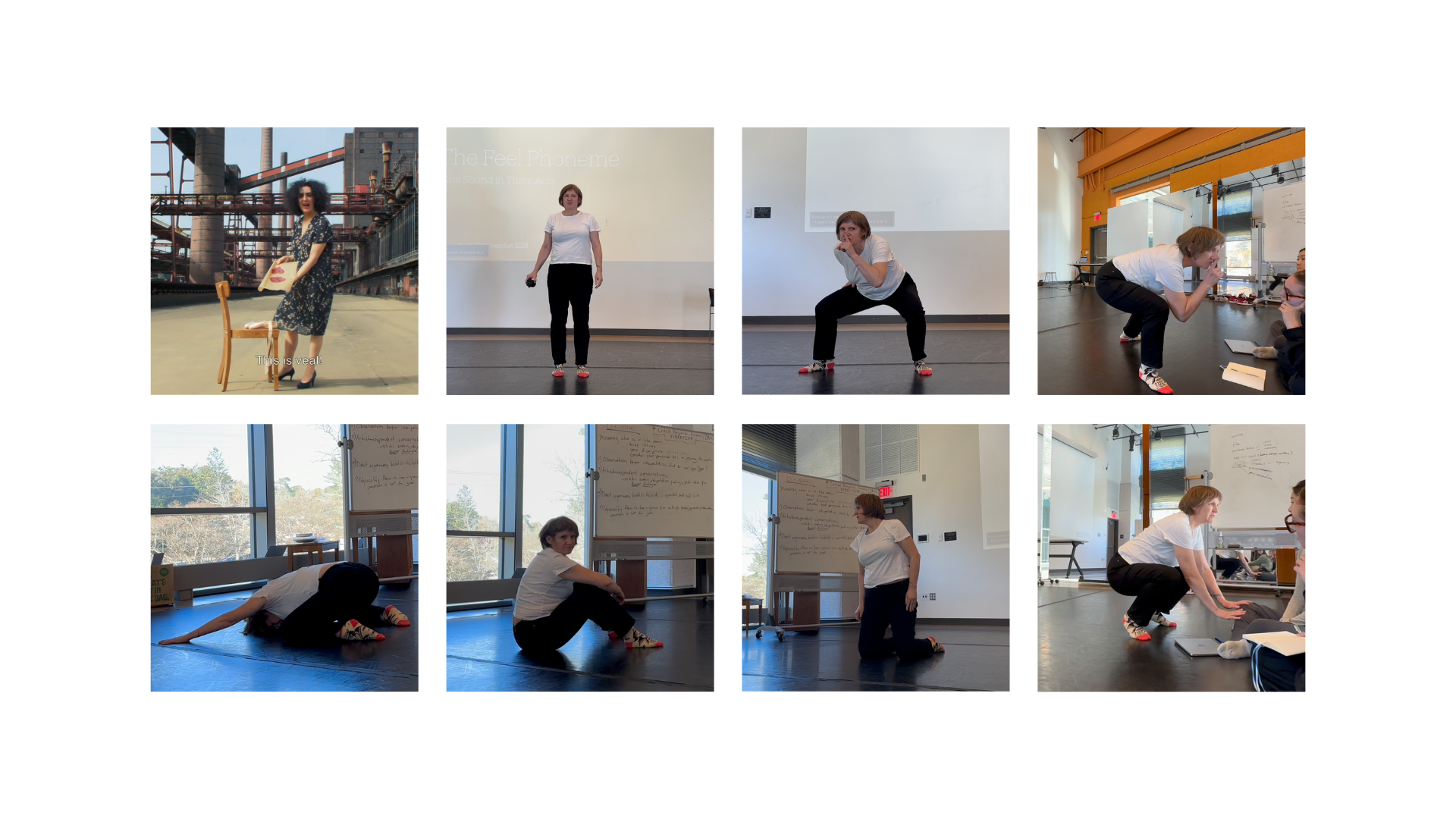
While my sequence of embodied silences is a repertoire in the generic sense, it is not precisely “repertoire” as Diana Taylor defines it for the purpose of correcting the archival bias of “history-as-discipline” (2006, 70–1). Taylor’s use of repertoire, distinct from the archive, refers to ritualized performances of historical events, including the “arrangements and relationships” enacted and embodied throughout the production process (72). Not only do these embodied practices recount history, she argues, but the strategies cultivated in the struggle to preserve what we might call “undocumented” culture through ritualized performance are at the same time the very materials of history in the making. My vicious looks, sheepish postures, hissing reprimands, and compassionate coos do not reenact any unique prior events, but they are most definitely “citational” behaviors (Schneider 2011, 98). I wish I could call them, after Michel de Certeau, my starter catalog of “tactical” silences (1984, xvii–xx), practices by which I reappropriate the spaces I move in. Instead, they are demonstrations of what Michel Foucault would call my “correct training” in disciplinary silence (1977, 170ff.), the norms that facilitate the circulation of power through the spaces I move in.
So my repertoire of silences reproduced the habitus of white supremacy and colonial power2 . I risked the harm and shame of this act in order to test Rebecca Schneider’s argument in Performing Remains, that, per Hamlet, “in the meantime” of the performance the “necessary question of the play” makes itself known (2011, 87–9). In my play, the question is the white woman’s body—to the extent that I embody it, to the extent that it embodies me—and what knowledge might lurk therein. Contra Taylor, who accepts the ephemerality of performance in elevating it to the status of documentary evidence, Schneider argues that repertoire leaves its traces: “In privileging an understanding of performance as a refusal to remain, do we ignore other ways of knowing, other modes of remembering, that might be situated precisely in the ways in which performance remains, but remains differently?” (98). To deny the embodiment of memory is to capitulate to the colonial logic of the archive, Schneider continues, to “overlook different ways of accessing history offered by performance” (ibid.). She points to Toni Morrison’s “re-memory,” Adrienne Rich’s “re-vision,” and Judith Butler’s “sedimented acts” accreting into a performance of gender (6–7). Unlike the “citational performance” called forth by these examples, my repertoire of embodied memory would not redress any archival silences of official history. Again, my gamble was that in the performance of an (ambivalent) sound paradoxically invested in (engendering) silence, I would not only cultivate a somatic awareness of my proximity to power and “hapticality,” but also ask new questions of my body and its position in our “structure of feeling3 ." And if Schneider is right, then something of my performance remains with us who were in that place at that moment, in 2025, enacting the repertoire of graduate-seminar learning in a private institution of higher education in the U.S.
Act II. [white noise continuing] At the table I advanced the slide, still unreadable: “violence.” I picked up the speaker and offered it to a member of the audience. I returned centerstage and kneeled in hero pose. Here I remained for the rest of the act, delivering four statements about violence and my body in about as many minutes, asking the audience to pass the speaker to someone else between statements. One violence: the bit of friction we create with our teeth in order to sound the phoneme: “sh.” [speaker passed, hands to my throat] Two violence: In my white woman’s body, I am positioned as both subject to and gatekeeper of patriarchal power. When I make the sound /sh/, I call back into my body the repertoire of silences I keep and command in all their violence. [speaker passed, breasts cradled] Three violence, my body is untouchable and therefore dangerous, dangerous and therefore untouchable. This is probably why I have witnessed more violence in the places I have called home than out in the world that, I am repeatedly told, wants to spoil me. [speaker passed, hands on my belly] Four violence, the time several years ago my mother told me that a neighbor once called the police on my father, back before my sister and I were born. Don’t tell your father I told you that. I learned a long time ago not to bring it up with him. I never have. Here I rose and collected the speaker from the audience, returned to hero pose centerstage, cupped the speaker between my hands at my chest, curled my back, tucked my chin, drew a long breath across the edges of my teeth, and let it spill down over the speaker on the way back out: “Sssssshhhhh.” End Act II.
To “move the bodily in the direction of the written,” Susan Leigh Foster writes in Choreographing History, the writing “must put into play figures of speech and forms of phrase and sentence construction that evoke the texture and timing of bodies in motion” (1995, 9). The monologue of Act II moved the repertoire of Act I and the scenarios it cites in the direction of the written. My writing here moves it further. Yet, Foster adds, the writing “must also become inhabited by all the different bodies that participate in the constructive process of determining historical bodily signification” (ibid.). For this reason I insinuated the speaker into the audience, to enact the imposition of whiteness on others as well as the innocence with which the imposition is accepted. I was told after the performance, to my delight, that the quality of the white noise shifted depending on where a person was seated and of course as I muffled the speaker to close the scene. When I held the feel phoneme’s resonance in my throat, my breast, my core, I broke a silence that protects my father from accountability but also my mother from possible harm. Nevertheless, I am aware that this intervention only scratches the surface of an inquiry into bodily history. What kinesthetic empathy I awakened between myself and my mother’s body or, for example, that of Carolyn Bryant, the white woman who allowed her body to justify the lynching of Emmett Till, does not excuse or minimize our complicity in supremacist regimes of violence. Its value will emerge from the heightened awareness of what is possible with a body like mine.
Act III. I advanced to the final slide, “touch,” rolled the table to centerstage. On the table were displayed three material objects that organize my body in history: my mother’s mother’s signet ring (center); a vintage Bull Durham tobacco pouch (my right); a waterlogged torn-open business envelope, postmarked to Atlanta from San Quentin State Prison and stamped “NSF” for “nonsufficient funds.” I placed the speaker under the table. When the speaker went silent, our time would be up. I described the three objects and asked the audience to come take a look, which would organize their bodies around the silences of my personal history weaving through the longer narratives of our collective history. I invited everyone to shush at the objects or hush them. I hoped we could explore the feel phoneme and sound the reach of our collective silences together. Some people picked up the objects and turned them over. To my recollection, only one person made the sound. She leveled it at my grandmother’s ring. Thinking I could move people into the spirit of “touching history,” I said, “I like to blow shushes into the tobacco pouch,” and I demonstrated. Still no takers. The audience returned to their seats. I sat with the speaker in my lap. End Act III.
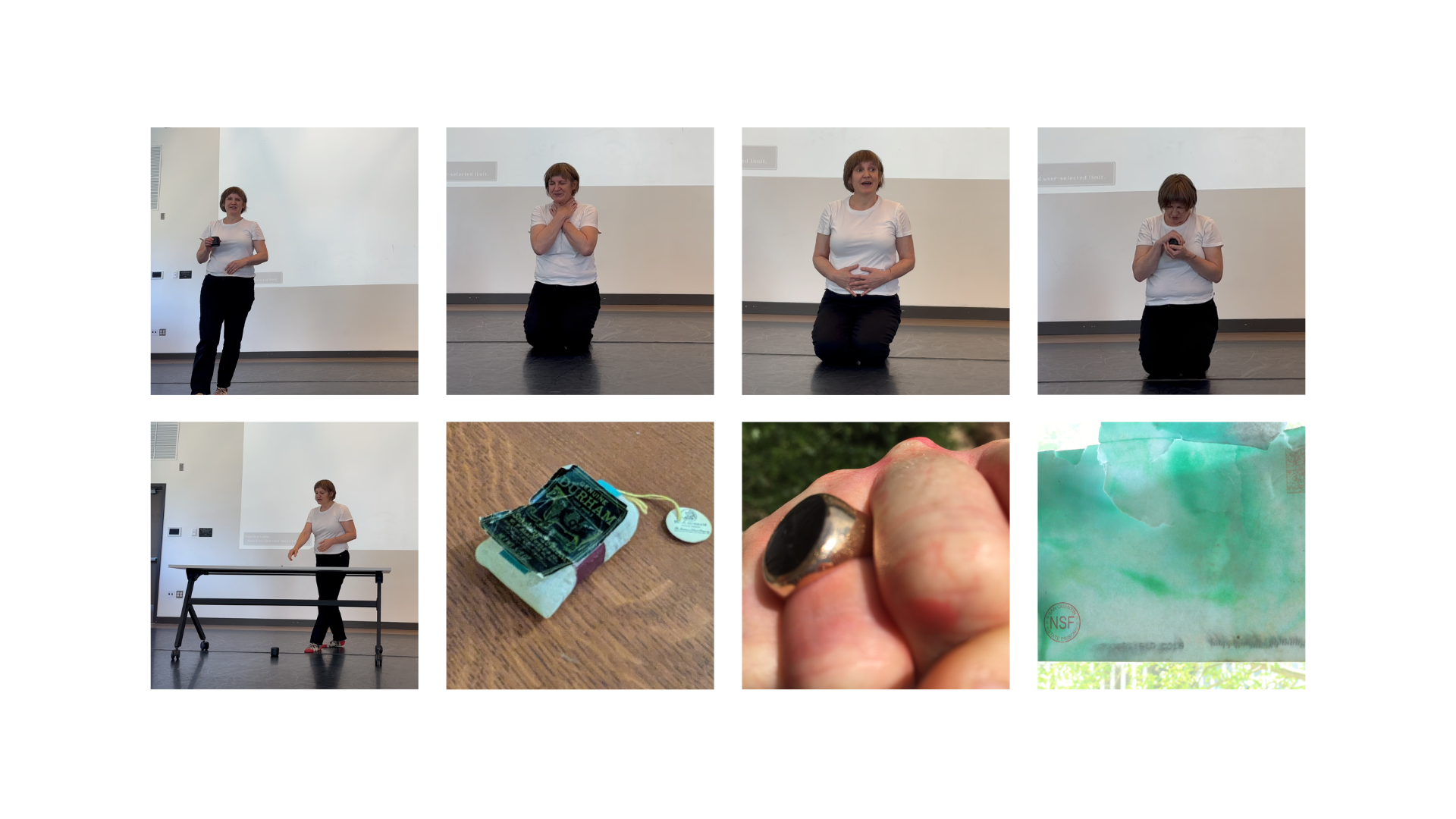
In “Touching History,” Ann Cooper Albright directs our attention to the somatic awareness we cultivate with the porous “interface” of our largest organ, the skin. “Reaching out to touch something or someone insists on its own reciprocity, for it is impossible to touch in a way that does not also implicate one’s own body. This is true in the case of fire and other people, as well as history” (2018, 74). By the same logic, it is impossible to make noise without implicating one’s own body. Says experimental filmmaker and sound artist Deborah Stratman, “Hearing is touch at a distance” (2024). Stanford psychologist Anne Fernald asserts the same of sound: it is “touch at a distance” (2007). Although skin and the sounding body share the perceptual sensitivity (and risks of reciprocity) that Albright ascribes to touch, the “distance” sound overcomes highlights a critical distinction between the two mediums. Skin is intrinsic to the body, whereas sound is ecstatic. The “feel for feeling others feeling you” is the ecstatic sound of history. As theorized by artist and scholar Ashon Crawley, Blackpentecostal breath is an ecstatic sound of history. Poet M. NourbeSe Philip’s ode to “w—” in Zong #1 is an ecstatic sound of history. The “Silent Choir” of protestors, water protectors, and land defenders—led by Indigenous women—that composer Raven Chacon recorded at the Oceti Sakowin camp near Standing Rock is an ecstatic sound of history. I call it the “feel phoneme” because it sounds my body’s proximity to hapticality, but /sh/, in all its registers, embodies the intrinsic sounds of history. Its paradoxical silence-not-silence is my body’s history to write.
[white noise ends] we heard what remained.
In How to Do Things with Words, philosopher J.L. Austin describes three aspects of performative speech. “Locutionary” refers to basic statement. “Illocutionary” refers to the force of the statement’s assertion. “Perlocutionary” refers to the effective impact of the asserted force (1962, 94–101). back to text
Here I use “habitus” as Pierre Bourdieu uses it in Outline of a Theory of Practice (1977) to characterize the dominant socially determined disposition, although I would like to reserve the possibility that performing this repertoire of /sh/ might serve the Aristotelian pedagogical function Saba Mahmood describes in “Feminist Theory, Embodiment, and the Docile Agent” (215-16). back to text
“Structure of feeling” is the term Marxist cultural theorist Raymond Williams uses to describe the competing social narratives at any moment in history (MacKenzie 2014, 607–13). I am suggesting that white women are positioned to bear witness both to white patriarchal power and the “insurgent feel” of the undercommons (Harney and Moten 2013, 97–8). back to text
Works Cited
With gratitude, I acknowledge the kinesthetic intelligence and generosity of my professor and co-
movers in the fall 2025 graduate seminar “Theories of Corporeality” at Duke University: Dr.
Jingqiu Guan, Celeste Brace, Haiyi Chen, Michela Dwyer, Grace Gibson, Lei He, Emily Mohr,
Sylvie Yuwei Wu, and Xinyi Zhang. Special thanks to Lei He for documenting my performance on her
iPhone. Screenshot of Cristiana Morganti from Pina. Photos of the tobacco pouch, ring, and
envelope are my own.
Albright, Ann Cooper. “Touching History.” In The Sentient Archive: Bodies, Performance, and Memory, eds. Bill Bissell and Linda C aruso Haviland. Wesleyan UP, 2018.
Austin, J.L. How to Do Things with Words. 1962. Second edition, eds. M. Sbisà and J.O. Urmson. Oxford UP, 1975.
Bourdieu, Pierre. Outline of a Theory of Practice. Cambridge UP, 1977.
Chacon, Raven. “Silent Choir.” 2017. On spiderwebsinthesky.com/silent-choir/. Accessed 23 October 2025.
de Certeau, Michel. The Practice of Everyday Life. 1977. Trans. Steven Rendall. U California Press. 1984.
Crawley, Ashon. “Breathing Flesh and the Sound of BlackPentecostalism.” Theology and Sexuality 19, no. 1 (2013). 49–60.
Foucault, Michel. “The Means of Correct Training.” In Discipline and Punish: The Birth of the Prison. 1975. Trans. Allan Sheridan. Vintage, 1977. 170–94.
Foster, Susan Leigh. “Choreographing History.” In Choreographing History. Ed. Susan Leigh Foster. Indiana UP, 1995. 3–21.
Harney, Stefano, and Fred Moten. “Fantasy in the Hold.” In The Undercommons: Fugitive Planning and Black Study. Minor Compositions, 2013.
Mahmood, Saba. “Feminist Theory, Embodiment, and the Docile Agent: Some Reflections on the Egyptian Islamic Revival.” Cultural Anthropology 16, no. 2 (2001). 202–36.
Philip, M. NourbeSe. Zong #1. Read and recorded at North of Invention: A Canadian Poetry Festival, 2011. On PennSound. Accessed 23 October 2025.
Schneider, Rebecca. “In the/ Meantime: Performance Remains.” In Performing Remains: Art and War in Times of Theatrical Reenactment. Routledge, 2011. 87–110.
Stratman, Deborah, and Sukhdev Sandhu. “Geologic Listening.” 2024. Union Docs.
Taylor, Diana. “Performance and/as History.” The Drama Review 50, no. 1 (2006). 67–86.
Wenders, Wim, dir. Pina. 2011; New York, NY: IFC Films, 2011. Streaming video.
Williams, Raymond. “From Preface to Film (UK, 1954).” In Film Manifestos and Global Cinema Cultures. Ed. Scott MacKenzie. University of California Press, 2014. 607–13.